The People's Commission to Make Our Children Healthy
Now convening — Montgomery County, PA
There is a particular kind of meeting that changes things. Not the kind where experts present findings to a room that nods and disperses. Not the kind where officials receive public comment for three minutes each before voting on a decision already made. Not a focus group, a panel, a webinar, a task force.
What we're building is a commission — a real one, in the old American sense of the word. A body empowered to investigate, to deliberate, and to recommend. A body whose authority comes not from appointment or accreditation but from the community itself, engaging one of the most important questions this county has ever put to itself:
What do we owe the children born in Montgomery County in the first 1,000 days of their lives?
What the Commission Is — and What It Isn't
The People's Commission to Make Our Children Healthy is a citizen-led deliberative body. It is not a government agency, not a nonprofit with a predetermined program, and not a research institute publishing papers. It is an organized, structured process by which the people of Montgomery County examine the evidence, hear testimony from those with relevant experience, and develop recommendations grounded in both the best available science and the lived reality of families in this county.
Its founding principle: the people closest to the challenges are closest to the solutions. A neonatal nurse from Einstein Medical Center has knowledge that a policy paper cannot capture. A Norristown grandmother raising her grandchildren knows things about what families actually need that no needs assessment fully represents. A new mother in Abington navigating the system alone understands barriers to care in ways that make her not a subject of study but a source of knowledge.
The Commission exists to gather that knowledge, combine it with the research evidence, and turn the result into actionable recommendations — for healthcare providers, county and municipal governments, employers, community organizations, and the state and federal policies that shape what families in this county can access.
How It Works — The Four Phases
Phase 1 — Foundation Now through Summer 2026
The Commission establishes its governance, convenes its members, and begins systematically mapping Montgomery County's first 1,000 days landscape. Community listening sessions open across the county — online and in person. A grassroots resource mapping effort invites community members to contribute knowledge about what is and isn't available in their neighborhoods.
Phase 2 — Investigation Summer through Fall 2026
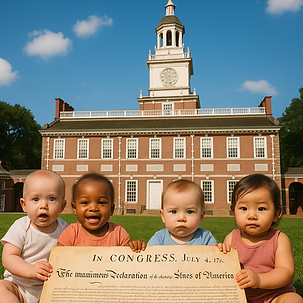
The Commission's formal inquiry begins. Public hearings receive testimony from healthcare providers, researchers, family members, policy experts, and community organizers. Using the six newborns as a diagnostic framework, the Commission examines the ecosystem surrounding each child: what resources are present, what is missing, and where systems break down.
Phase 3 — Deliberation and Recommendations Fall through Winter 2026
The Commission synthesizes what it has learned and develops its policy recommendations. Draft recommendations are published for public review before they are finalized. Collaborative policy workshops bring diverse stakeholders together to co-draft proposals — built for Montgomery County, modeled for communities nationwide.
Phase 4 — Accountability 2027 and beyond
Recommendations become action plans — with implementation assignments, timelines, and public accountability mechanisms. The Commission tracks whether its recommendations are being acted on and reports publicly on what is working and what is not.
The Role of AI — Four Words
The Commission uses AI tools to help analyze research, surface community knowledge, and connect testimony to relevant evidence. But the governing principle is simple and non-negotiable:
AI recommends. Humans decide.
No algorithm determines what the Commission concludes. The technology serves the deliberation; the deliberation belongs to the community. Every AI-assisted summary is reviewed, challenged, and accepted or rejected by Commission members — and the community can see exactly how AI is used.
Who Sits at the Table
Commission membership is drawn from across Montgomery County's full range of experience and expertise. Healthcare providers, parents and families, educators, social service providers, faith leaders, business representatives, researchers, and young adults all have a place. No single sector dominates.
Commission members are compensated for their time. Childcare and transportation are provided for in-person sessions. The participation barrier has been deliberately lowered, because the Commission cannot do its work without the people who are hardest to reach.
Join the Commission
The Commission is actively recruiting members and community participants. Applications are open to all Montgomery County residents.